Database Design Book
Table of Contents
Purchase: Database Design Book.
1. Introduction
- 1.1 Who is this book for?
- 1.2 What level of understanding is this book aimed at?
- 1.3 What you would get from reading this book
- 1.4 Who I am
2. Building a logical model
- 2.1 System requirements as input
- 2.2 Who do we write the logical model for?
- 2.2.1 For yourself
- 2.2.2 For software developers
- 2.2.3 For the project group
- 2.3 Can I skip the logical model?
- 2.4 Can I use an ERD instead?
- 2.5 Elements of a logical model
- 2.6 The process
- 2.7 Anchors: introduction
- 2.7.1 Example: posts
- 2.7.2 A list of anchors
- 2.7.3 Example: invoices
- 2.7.4 Anchor IDs
- 2.8 Attributes: introduction
- 2.8.1 Attributes: definition
- 2.8.2 Attributes and anchors
- 2.8.3 Human-readable questions
- 2.8.4 Example values
- 2.8.5 Data types and types of data
- 2.8.6 What is not an attribute?
- 2.8.7 How to confirm that all the attributes have been listed?
- 2.9 Links: introduction
- 2.9.1 Links: definition
- 2.9.2 Links: pair of anchors
- 2.9.3 Links: cardinality
- 2.9.4 Cardinality is a business concern
- 2.9.5 Links: sentences
- 2.9.6 False links and unique pairs of IDs
- 2.10 More on anchors
- 2.10.1 Unique attributes
- 2.10.2 Optional unique attributes
- 2.10.3 External IDs
- 2.10.4 External ID enumeration
- 2.10.5 Several unique IDs
- 2.10.6 Implementing physical IDs
- 2.11 Handling time in the logical model
3. “Hello world” use case: podcast catalog
- 3.1 Business requirements
- 3.2 Anchors
- 3.3 Attributes
- 3.4 Links
- 3.5 Cross-checking the requirements
- 3.6 A diagram
- 3.7 Are we there yet?
- 3.8 Evolving the system
4. Building a physical schema
- 4.1 Many table design strategies are possible
5. Table-per-anchor table design strategy
- 5.1 Action plan
- 5.2 Anchors: choosing table names
- 5.3 Attributes: choosing column names
- 5.4 Attributes: choose column data types
- 5.4.1 Recommended physical types for SQL databases: summary
- 5.4.2 Strings
- 5.4.3 Integer numbers
- 5.4.4 Monetary amounts
- 5.4.5 Numeric values
- 5.4.6 Yes/no values
- 5.4.7 Either/or/or values
- 5.4.8 Dates
- 5.4.9 Date with time in UTC timezone
- 5.4.10 Date with time in a specific timezone
- 5.4.11 Timezone names
- 5.4.12 Binary blobs
- 5.5 Links
- 5.5.1 One-to-many (1:M) links
- 5.5.2 An ID cannot be an attribute value
- 5.5.3 Many-to-many (M:N) links
- 5.6 Podcast catalog: a complete physical schema
- 5.6.1 CREATE TABLE statements
- 5.6.2 Audio file and cover images
- 5.7 Physical ID design
- 5.7.1 Case study: a tiny CMS
- 5.7.2 The maximum number of items
- 5.7.3 Reaching the maximum number of items
- 5.7.4 Space taken by IDs
- 5.7.5 Disk space is time
- 5.7.6 Storage density
- 5.7.7 UUIDs as anchor IDs
- 5.7.8 Countries, currencies, languages: well-known anchors
- 5.7.9 Countries, currencies, and languages in your business
- 5.8 Handling time in the physical model
6. Other table design strategies
- 6.1 Table design concerns
- 6.2 Is there a recommended table strategy?
- 6.3 Table-per-anchor, revisited
- 6.4 Side tables
- 6.4.1 Naming and composition of side tables
- 6.4.2 A stopgap table
- 6.5 JSON columns
7. Dealing with absent data
- 7.1 Use case: user’s bio
- 7.2 Sentinel values: NULL
- 7.3 Other sentinel values
- 7.4 Sentinel values exist only on a physical level
- 7.5 Explicit reasons for missing data
- 7.6 Summary
8. Secondary data
- 8.1 Cached column example
- 8.2 There is no free lunch
- 8.3 Cached column is not an attribute
- 8.4 Discovering secondary data
9. Evolving your database
- 9.1 Elementary database migrations
- 9.2 Table rewrite
- 9.3 Adding an attribute
- 9.3.1 Step 1: Update logical model
- 9.3.2 Step 2. Run database migration
- 9.3.3 Step 3. Update code
- 9.4 Dealing with table rewrite
10. Movie tickets: repeated sales pattern
- 10.1 Business requirements
- 10.2 Per-department modeling
- 10.3 Movies department
- 10.4 Maintenance department
- 10.5 Movie schedule department
- 10.6 Tickets department
- 10.7 A diagram
- 10.8 Conclusion
11. Books and washing machines: polymorphic data pattern
- 11.1 Business requirements
- 11.2 Per-department modeling
- 11.3 Key insight: generic anchor vs specific anchors
- 11.4 Multiplexing on item type
- 11.5 Tangled links
- 11.6 A diagram
- 11.7 Table-per-anchor approach
- 11.8 Polymorphic table design strategy
- 11.8.1 JSON-based columns
- 11.8.2 Physical schema
- 11.8.3 Storing links in JSON
- 11.8.4 Table design concerns, revisited
- 11.8.5 Documenting physical storage
12. Practicalities
- 12.1 Document-based catalog
- 12.2 Spreadsheet-based catalog
- 12.3 How much to write
- 12.4 Lightweight designs
“Database Design Book” (2025)
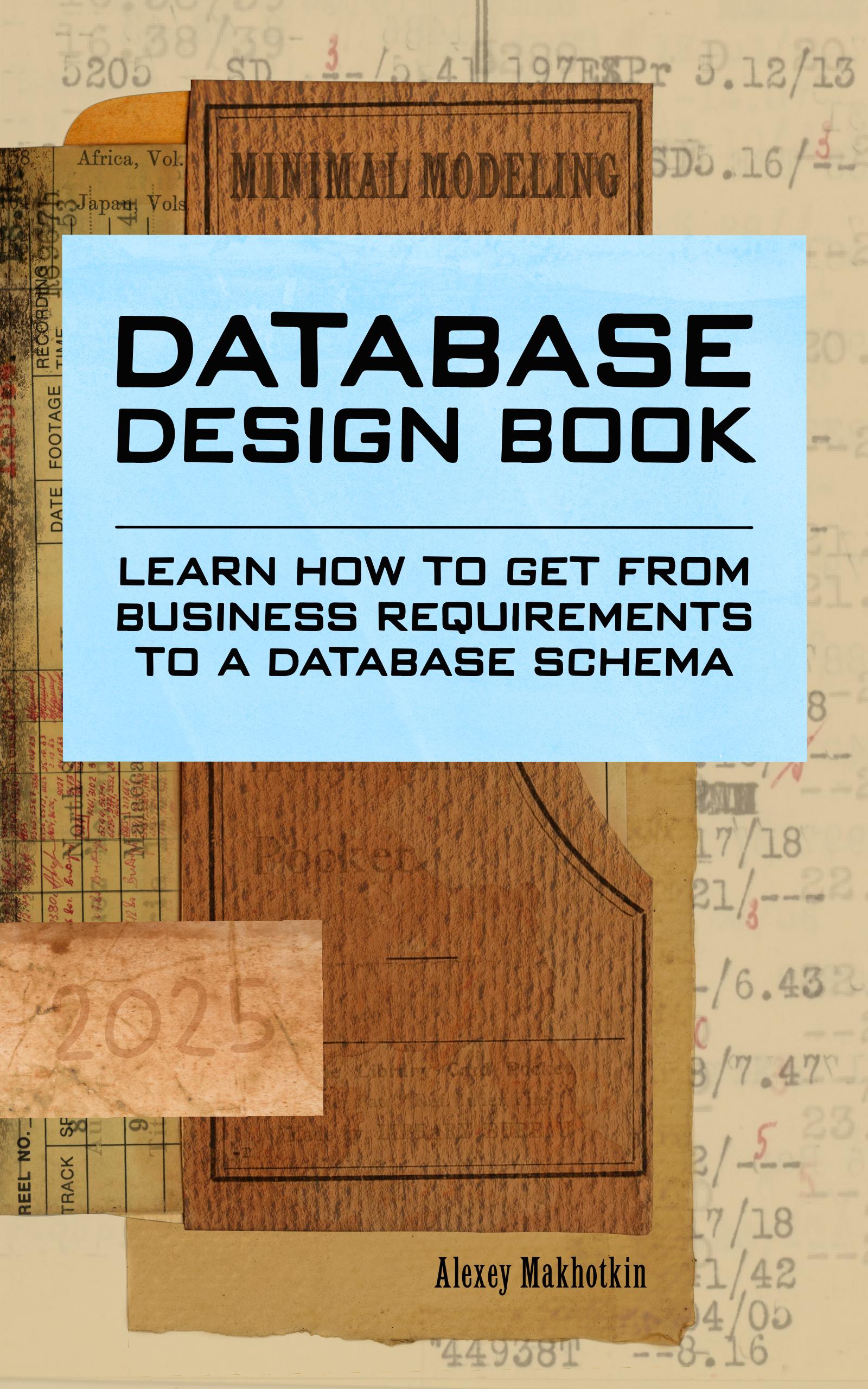
Learn how to get from business requirements to a database schema
If this post was useful, you may find this book useful too.
Table of contents and sample chapters
Book length: 145 pages, ~32.000 words. Available in both PDF and in EPUB format.